
How White-Paper Manufacturing Works in Nigeria: From Cassava to Copier Paper
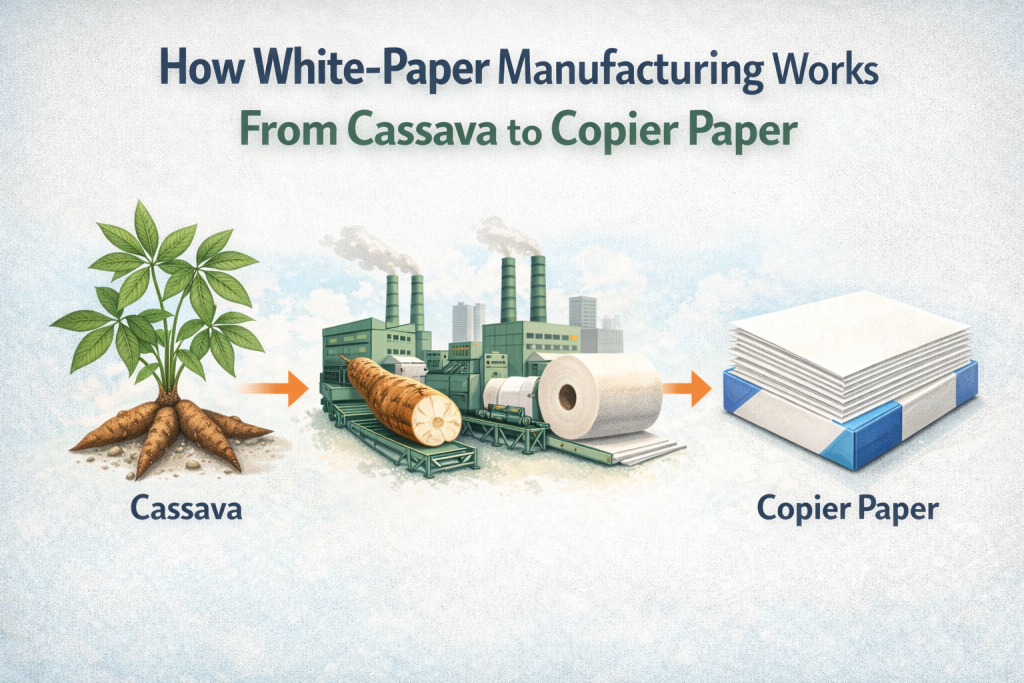
When most people think about paper, cassava is probably not the first thing that comes to mind. Yet in Nigeria, cassava plays a surprisingly important role in the journey from raw materials to the white copier paper used in offices, schools, and businesses every day.
Understanding how white paper is manufactured locally helps highlight the value of domestic production, its economic impact, and the opportunities it creates across agriculture, manufacturing, and supply chains.
The Role of Cassava in Paper Production
Cassava is widely grown across Nigeria and is best known as a staple food crop. However, one of its by-products, industrial starch, is essential in paper manufacturing.
In paper production, cassava starch is mainly used during the finishing stages. It improves paper strength, enhances surface smoothness, and helps the paper perform better during printing and copying. This is especially important for copier and printing paper, where durability and print quality matter.
By using cassava starch sourced locally, paper manufacturers can reduce reliance on imported additives while supporting Nigerian farmers and agro-processors.
Step One: Sourcing and Preparing Raw Materials
The core raw material for white paper is pulp, which comes from processed plant fibers. In Nigeria, this pulp is largely imported due to limited local pulp production capacity. However, supporting materials like cassava starch, water, and processing chemicals are often sourced locally.
Cassava roots are processed into starch through washing, grinding, filtration, and drying. Once refined, the starch is supplied to paper mills for use during paper finishing and coating.
Step Two: Pulp Processing and Stock Preparation
At the paper mill, pulp is mixed with water to form a slurry known as stock. This mixture is carefully refined to achieve the right fiber length and consistency needed for smooth, high-quality paper.
At this stage, additives such as fillers and strengthening agents are introduced. Cassava starch is added here to improve fiber bonding, which gives the paper better strength and print performance.
Step Three: Sheet Formation
The prepared stock is spread evenly onto a fast-moving wire mesh on the paper machine. Water drains away, leaving behind a thin mat of fibers. This is where the paper sheet begins to take shape.
Precision is critical at this stage. The thickness, weight, and uniformity of the paper are controlled to ensure it meets the standards required for copier and printing use.
Step Four: Pressing and Drying
The newly formed paper sheet passes through a series of rollers that press out excess water. It then moves through heated drying cylinders that remove remaining moisture.
This drying process is what gives white paper its stability and readiness for further treatment. Proper drying ensures the paper will not warp or curl during printing or copying.
Step Five: Surface Treatment and Starch Application
This is where cassava starch plays a key role.
The paper passes through a sizing or coating stage where starch is applied to the surface. Cassava starch improves surface smoothness, ink absorption, and resistance to tearing. For copier paper, this step ensures clean printing, reduced paper jams, and longer machine life.
Using locally sourced starch reduces production costs and strengthens Nigeria’s agro industrial value chain.
Step Six: Cutting, Finishing, and Packaging
Once the paper meets quality standards, it is cut into standard sizes such as A4, A3, or letter format. The sheets are counted, wrapped, and packaged for distribution.
Quality checks are carried out to ensure brightness, thickness, moisture content, and performance meet both local and international standards.
Why Local White-Paper Manufacturing Matters
Producing white paper locally offers several benefits:
It reduces Nigeria’s dependence on imported paper products
It conserves foreign exchange
It creates jobs across agriculture, logistics, and manufacturing
It supports cassava farmers and agro processors
It strengthens industrial self-sufficiency
By linking agriculture to manufacturing, white paper production becomes a powerful example of how Nigeria can add value locally instead of exporting raw potential.
Conclusion
With the right investment, policy support, and infrastructure, Nigeria’s paper industry has the potential to meet a much larger share of domestic demand. Expanding local pulp production and deepening the use of agricultural inputs like cassava starch will be key to long term sustainability.
