
Guide to Choosing the Right Paper Types for Printing, Packaging, and Publishing in Nigeria
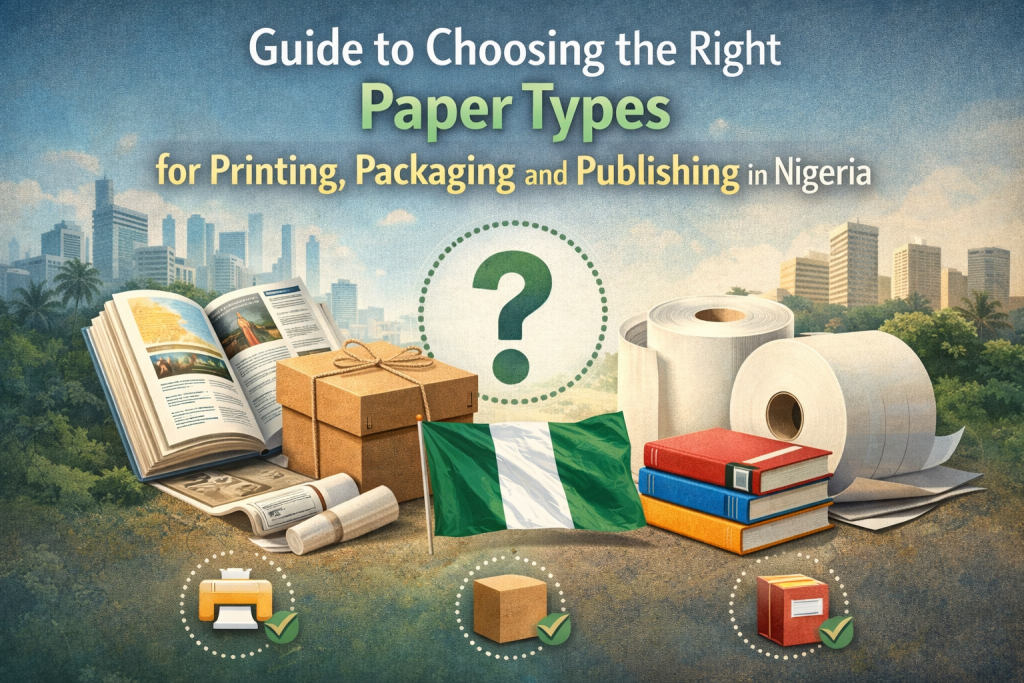
Paper plays a far bigger role in business than many people realize. Whether you are printing marketing materials, packaging products, or publishing books and educational resources, the type of paper you choose directly affects quality, cost, durability, and brand perception.
In Nigeria’s fast-growing commercial and industrial landscape, understanding paper types is essential for making smart purchasing decisions. This guide breaks down the most common paper options used for printing, packaging, and publishing, and explains how to choose the right one for your needs.
Understanding Paper Basics
Before choosing a paper type, it helps to understand a few basic terms:
- GSM (Grams per Square Meter): This measures paper weight and thickness. Higher GSM means thicker and heavier paper.
- Finish: Paper can be coated or uncoated, affecting texture, appearance, and ink absorption.
- Brightness and Whiteness: These influence how sharp text and images appear.
- Strength and Durability: Especially important for packaging and high-use publications.
Each application requires a different balance of these factors.
Paper Types for Printing
Printing paper is commonly used for marketing materials, office documents, magazines, and promotional items.
1. Bond Paper (Copier Paper)
This is the most common paper used in offices and commercial printing.
Best for:
- Office documents
- Flyers and handbills
- Letters and reports
Why choose it:
Bond paper is affordable, widely available, and works well with printers and photocopiers. It is typically uncoated, allowing ink to absorb quickly and dry fast.
2. Art Paper (Coated Paper)
Art paper comes in glossy or matte finishes and has a smooth coated surface.
Best for:
- Brochures and catalogs
- Magazines
- High-quality marketing materials
Why choose it:
The coating allows for sharper images and vibrant colors, making it ideal for visually rich designs.
3. Cardstock
This is a thicker, more rigid paper compared to regular printing paper.
Best for:
- Business cards
- Certificates
- Invitations and covers
Why choose it:
Cardstock offers durability and a premium feel, which enhances brand perception.
Paper Types for Packaging
Packaging paper must protect products while also supporting branding and logistics.
1. Kraft Paper
Kraft paper is strong, durable, and typically brown, though white variants are also available.
Best for:
- Shopping bags
- Wrapping paper
- Food packaging
- Inner packaging layers
Why choose it:
Kraft paper is tear-resistant, cost-effective, and widely associated with eco-friendly packaging.
2. Corrugated Paper (Cartons)
This paper consists of fluted layers sandwiched between liner boards.
Best for:
- Shipping boxes
- Product cartons
- Heavy-duty packaging
Why choose it:
Corrugated paper offers excellent protection for goods during transportation and storage, making it essential for logistics and distribution.
3. Duplex Board
Duplex board has a white printed surface and a gray or kraft backing.
Best for:
- Product cartons
- Retail packaging
Why choose it:
It combines strength with good print quality, making it suitable for branded packaging.
Paper Types for Publishing
Publishing paper focuses on readability, durability, and long-term use.
1. Book Paper (Cream or White)
This paper is designed for comfortable reading.
Best for:
- Textbooks
- Novels
- Educational materials
Why choose it:
Book paper reduces glare, improves readability, and balances durability with cost efficiency.
2. Newsprint
Newsprint is lightweight and inexpensive.
Best for:
- Newspapers
- Inserts and flyers
Why choose it:
It is cost-effective for high-volume printing, though not suitable for long-term preservation.
3. Offset Paper
Offset paper is uncoated and designed for professional publishing presses.
Best for:
- Journals
- Manuals
- Workbooks
Why choose it:
It offers consistent print quality and durability for frequent handling.
Key Factors to Consider Before Choosing Paper
When selecting paper in Nigeria, consider the following:
- Purpose: Is it for branding, protection, or reading?
- Cost: Balance quality with budget, especially for large volumes.
- Durability: Will the paper be handled often or exposed to moisture?
- Print Method: Different papers perform better with specific printing technologies.
- Sustainability: Eco-friendly paper options are increasingly important for modern brands.
Why Local Paper Manufacturing Matters
Choosing locally manufactured paper supports Nigeria’s economy, reduces dependence on imports, and ensures faster supply chains. Local production also helps businesses manage costs more effectively while supporting job creation and industrial growth.
Conclusion
Selecting the right paper type is not just a technical decision; it is a strategic one. The right choice improves product quality, strengthens branding, and ensures cost efficiency across printing, packaging, and publishing.
By understanding the strengths of different paper types and matching them to your specific needs, businesses and publishers in Nigeria can make smarter decisions that deliver better results.
If you need guidance on sourcing high-quality paper solutions tailored to your business needs, working with experienced local manufacturers can make all the difference.
